
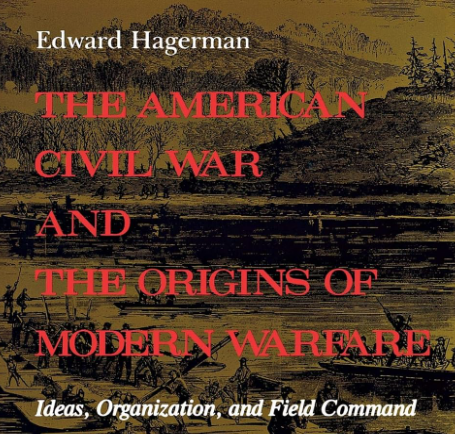
A critical review of Edward Hagerman’s study of ideas, organization, and field command
Edward Hagerman. The American Civil War and the Origins of Modern Warfare. Bloomington: Indiana University Press, 1988.
REVIEW AT A GLANCE
Hagerman’s central argument is that industrial technology, military organization, geography, and inherited doctrine interacted to reshape Civil War strategy and tactics.
Hagerman connects rail logistics, staff work, rifled weapons, field engineering, and entrenchment into a single analytical framework.
The continued relevance of this work lies in the book’s invitation to readers to ask how armed forces adapt doctrine and institutions when technology changes faster than military habits.

Figure 1. 26th New York Infantry at Fort Lyon, Virginia, between 1861 and 1865. Library of Congress, LCCN 2012649362.
Why This Book Matters
The human and military scale of the conflict. The American Civil War produced immense death and suffering. The traditional estimate exceeds 620,000 military deaths, while a later demographic reassessment places the likely total near 750,000 (Hacker 2011, 307–348). Beyond its social consequences, the conflict accelerated changes in warfare as industrial-era transportation, weapons, communications, and production were applied to mass citizen armies.
Hagerman’s guiding problem. In The American Civil War and the Origins of Modern Warfare, Edward Hagerman examines how developments in logistics, weapons, transportation, organization, and field engineering influenced the emergence of modern strategy and more systematic entrenchment.
TERMS IN CONTEXT
Citizen armies — large forces drawn mainly from civilians mobilized for wartime service rather than from a small permanent professional army.
Modern warfare — used here as an interpretive label for industrialized mass war: large armies supported by rail, complex supply systems, specialized staffs, expanding firepower, and field fortifications.
Military revolution — a major change in the conduct of war produced by the interaction of technology, organization, doctrine, and society; it is more than the introduction of a single weapon.TEXT
Thesis and Analytical Framework
Hagerman’s thesis. A former associate professor of history at York University, Hagerman frames the book as a “study of how tactical and strategic ideas and organizations evolved in response to mid-nineteenth-century American industrial technology, society, ideology, and geography, as well as to the tactical and strategic objectives of Civil War armies” (Hagerman 1988, xviii). This formulation places institutions and ideas alongside weapons and machines.
Doctrine meets circumstance. Hagerman argues that nineteenth-century American armies inherited a largely European, antebellum body of military theory. Their leaders then had to adapt that inheritance to continental distances, uneven infrastructure, mass mobilization, and the operational demands of two major theaters of war.
DEFINITION: JOMINIAN TRADITION
A school of military thought associated with Antoine-Henri Jomini. In simplified form, it emphasized concentrated force, decisive points, lines of operation, and the destruction or defeat of the enemy’s principal army. Hagerman uses the term to explain the conceptual inheritance shared by many Union and Confederate officers.
Organization and Scope of the Book
Eastern Theater development. The book proceeds thematically, beginning with George B. McClellan’s reorganization of the Union army in the East and tracing the consequences from First Manassas through Chancellorsville and the post-Gettysburg period. Rather than offering another continuous battle narrative, Hagerman reconstructs the military ideas that commanders brought to the field and evaluates how experience altered those ideas.
A shared problem for both sides. He next examines Confederate organizational revisions and operational employment in the Eastern Theater. Hagerman concludes that “Confederate, like Union, strategists were raised in the Jominian tradition emphasizing the destruction of the enemy’s army,” yet both sides understood how difficult that objective was under mid-nineteenth-century American conditions (Hagerman 1988, 102).
Western Theater and entrenchment. The second half turns to the growth of trench warfare in the Western Theater, its influence on strategic thought, and the relationship between engineering capacity and increasingly attritional operations. Attritional warfare seeks to wear down an opponent through cumulative losses in personnel, equipment, position, or will, rather than relying solely on one decisive maneuver or battle.

Figure 2. Pathways from mid-century change to operational adaptation and battlefield effect. Interpretive synthesis based on Hagerman (1988).
Technology, Mobility, and Entrenchment
Logistics as combat power. Hagerman’s strongest analysis connects specific campaigns to shifts in transportation and supply. Railroad exploitation increased the speed and volume with which armies could be sustained, while improved administrative practices reduced the burden of wagon trains. He writes that “the condensation of rations and the streamlining of the train that had been going on since 1862—culminating in the flying column—all increased the army’s mobility away from its base of supply” (Hagerman 1988, 246).
A flying column is a deliberately mobile force traveling with reduced baggage and supplies so that it can move rapidly and operate temporarily at distance from a fixed base. A base of supply is the depot, railhead, port, or network from which an army receives food, ammunition, equipment, and replacements.
Firepower and field engineering. Mobility did not eliminate battlefield vulnerability. Improvements in rifled weapons, combined with artillery, disciplined mass fire, and the experience of repeated campaigns, encouraged greater use of cover and field fortifications. Field engineering includes the practical construction of earthworks, roads, bridges, obstacles, and defensive positions to support operations. Hagerman’s broader point is that logistics, firepower, staff work, and engineering reinforced one another, helping produce forms of warfare later associated with industrial conflict.

Figure 3. Aquia Creek Landing, Virginia: clerks of the commissary depot beside a railroad car and packing cases, February 1863. Photograph by Alexander Gardner. Library of Congress, LC-DIG-cwpb-03974.
Assessment and Relevance to Modern Warfare
The book’s contribution. Hagerman offers a robust framework for understanding Civil War strategy, tactics, and military change. His principal strength is synthesis: he shows why new tools mattered only when armies developed the organizations, staff functions, logistical systems, and field practices needed to employ them.
A productive line of inquiry. Civil War scholars and military historians can use the book as a foundation for comparative research into World War I, World War II, and the development of maneuver warfare. Such comparisons should be made carefully; continuity does not mean that later wars simply reproduced the conditions of the Civil War. The value lies in tracing recurring problems—adaptation, sustainment, command, dispersion, protection, and the tension between mobility and firepower—across different technological settings.


References
Hacker, J. David. 2011. “A Census-Based Count of the Civil War Dead.” Civil War History 57 (4): 307–348. https://doi.org/10.1353/cwh.2011.0061.
Hagerman, Edward. 1988. The American Civil War and the Origins of Modern Warfare: Ideas, Organization, and Field Command. Bloomington: Indiana University Press.
Library of Congress. n.d. “26th New York Infantry, Fort Lyon, Virginia.” Prints and Photographs Division. LCCN 2012649362. https://www.loc.gov/pictures/item/2012649362/.
Library of Congress. 1863. “Aquia Creek Landing, Va. Clerks of the Commissary Depot by Railroad Car and Packing Cases.” Photograph by Alexander Gardner. LC-DIG-cwpb-03974. https://www.loc.gov/pictures/resource/cwpb.03974/?co=civwar.