
Modern conflict presents an unusual challenge for the wargame designer. A hypothetical confrontation in the South China Sea would probably not begin with armies crossing borders or fleets immediately exchanging missiles. Instead, a crisis might develop gradually through competing territorial claims, diplomatic pressure, economic interests, freedom-of-navigation operations, military deployments, and increasingly dangerous confrontations at sea.
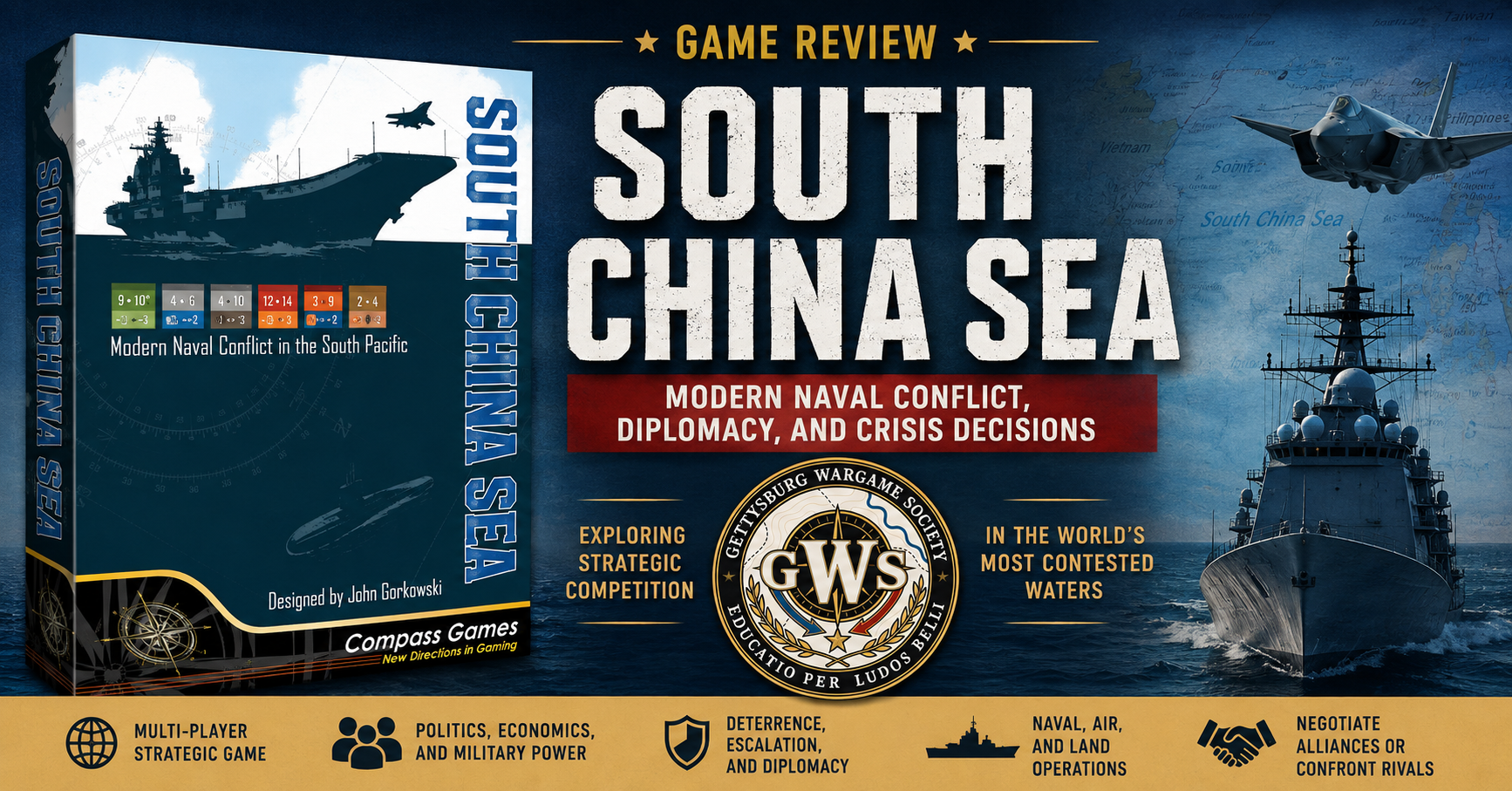
That complicated environment forms the basis of Compass Games’ South China Sea, designed by John Gorkowski. Rather than simply asking which player possesses the strongest fleet or can destroy the most enemy units, the game examines a considerably more interesting strategic problem: how can a nation accomplish its political objectives when military force is available, but using too much of that force may produce a larger disaster?
The result is a wargame that sits somewhere between a traditional military simulation and a geopolitical crisis game. Naval forces, aircraft, ground units, bases, and military operations are certainly important, but they exist within a broader contest involving diplomacy, economics, political influence, deterrence, and escalation. For students of military history and contemporary strategy, that makes South China Sea particularly interesting.
A Crisis Before the War
Most traditional wargames begin after political leaders have already made the decision to fight. When we sit down to play a Gettysburg game, for example, the American Civil War had already been underway for more than two years. In a Normandy game, the Allied decision to invade Europe had already been made. The player’s responsibility is primarily to determine how military forces should be employed once the shooting began. South China Sea approaches the problem differently.
The players enter an environment in which peace still exists, but beneath that peace are competing national objectives that may eventually produce armed conflict. China, Vietnam, the Philippines, Malaysia, and other regional actors have interests in the South China Sea, while the United States has its own strategic concerns regarding freedom of navigation, regional alliances, and the balance of power in the Western Pacific.
This means that military forces are not simply combat pieces waiting to attack. Their presence can itself become a political act. Moving naval forces into a disputed area might reassure an ally, intimidate an opponent, demonstrate national resolve, or protect an important interest. At the same time, exactly the same deployment might be interpreted by another player as preparation for an attack.
The game consequently forces players to consider not only what their military forces can do, but what their movements might communicate to everyone else sitting around the table. That distinction is central to understanding South China Sea.
Politics, Economics, and Military Power
The strategic competition depicted in South China Sea occurs simultaneously in the political, economic, and military arenas. These are not isolated systems. Instead, decisions made in one area can affect the options available in another.
A player attempting to expand political influence may discover that military deployments strengthen his negotiating position. Economic interests may make control of a particular area increasingly important. Conversely, an overly aggressive military posture may encourage previously divided opponents to cooperate against the player they now perceive as the greatest threat. This interaction gives the game much of its character.
The strongest military player cannot simply treat every problem as something that can be solved by moving units and attacking. Military superiority certainly provides options, but the purpose of those capabilities is ultimately political. A player who wins a military confrontation while simultaneously creating a hostile regional coalition may discover that his tactical victory has produced a strategic defeat. This is one of the game’s most valuable lessons.
Military power is a tool of national policy, not an end in itself.
Playing the Game

A session of South China Sea develops as players maneuver for political, economic, and strategic advantage while deciding how aggressively they are willing to employ their military capabilities.
Initially, much of the tension comes from positioning and political maneuvering rather than outright warfare. Players must assess their competitors’ intentions while pursuing their own objectives. Naval and air forces can be repositioned, political influence can shift, and competing states can attempt to strengthen their positions without necessarily crossing the threshold into open warfare.
The uncertainty surrounding those decisions creates much of the drama.
Imagine that one player moves naval forces toward a disputed area. The deployment may simply be intended to demonstrate resolve. Another player, however, cannot know that with certainty. He may respond by deploying additional ships or aircraft. A third player, concerned that a confrontation is developing, may begin strengthening his own position.
Nobody necessarily intended to start a war. Yet each player has taken an individually rational step to protect his interests, and the cumulative result is a much more dangerous strategic situation.
This produces one of the most interesting questions in the game: How do you convince another player that you are willing to fight without actually causing the war you are attempting to deter? That is not merely a gaming problem. It is one of the fundamental problems of deterrence and international relations.
Diplomacy Around the Table
The multiplayer nature of South China Sea makes diplomacy particularly important because the participants do not necessarily fall into two permanent and predictable alliances.
Each power approaches the crisis with different interests and capabilities. A smaller regional state may seek outside support against a stronger competitor without wanting to become completely dependent upon that support. The United States may wish to reassure regional partners while avoiding actions that unnecessarily escalate the crisis. China may attempt to expand its regional position while simultaneously preventing its competitors from forming a unified coalition.
Those competing interests create opportunities for negotiation.
Players may cooperate because their objectives temporarily overlap, but those arrangements do not necessarily survive for the entire game. A nation that is useful during one phase of the crisis may become a competitor during another, creating a very different atmosphere from the traditional two-player wargame. There is no guarantee that every problem can be understood simply by identifying “our side” and “their side.” Instead, the political landscape can shift as the situation develops.
For a wargaming group, this can produce some of the most memorable moments of the game. The conversation across the table becomes almost as important as the movement of counters across the map.
When Diplomacy Gives Way to War
Eventually, political maneuvering may fail. A player may conclude that military force offers the best opportunity to accomplish his objectives, or events may escalate until armed confrontation becomes unavoidable.
At that point, the military capabilities represented on the map become increasingly important.
Modern naval warfare is fundamentally different from the warfare represented in many historical games. Surface ships, submarines, aircraft, ground forces, bases, and amphibious capabilities operate within an environment dominated by detection, operational reach, long-range weapons, and extremely lethal combat systems.
Positioning therefore becomes critical.
A naval force may possess tremendous offensive power, but that same force represents an enormously valuable asset that can be placed at risk. Aircraft may dramatically extend a player’s military reach, but their effectiveness is connected to the location of bases and supporting infrastructure. Islands and coastal positions that appear insignificant when looking at a normal map can suddenly become strategically important because of the military capabilities they support.
The game thus encourages the player to think operationally rather than merely tactically.
The question is not simply whether one ship can defeat another. The more important question is how military power can be projected across the region and whether that power can be sustained long enough to accomplish the player’s political objectives.
Geography Becomes Strategy

One of the benefits of playing a map-based simulation such as South China Sea is that the strategic geography of the region becomes much easier to understand.
When reading about the South China Sea, names of islands, reefs, ports, bases, and maritime passages can quickly become abstract. Once those same locations appear on a game map and begin affecting your decisions, their importance becomes much clearer.
Distances suddenly matter. The location of airfields matters. Access to ports matters. The ability to project aircraft or naval forces into a particular area matters.
A player soon begins asking the same basic questions that military planners have always asked. Where can my forces operate? How quickly can they reach an objective? What supports them once they arrive? Which locations provide an advantage? Where are my forces vulnerable? What geographic positions does my opponent require to accomplish his own objectives?
In this respect, South China Sea demonstrates one of the great educational advantages of wargaming. Geography that seems relatively unimportant on a conventional political map can become immediately understandable when the player must make decisions within it.
The Escalation Problem
Perhaps the most fascinating aspect of South China Sea is the way it encourages players to think about escalation. In many historical wargames, escalation is largely irrelevant because the war has already begun. The player does not need to decide whether firing on the enemy will cause a conflict. The conflict already exists. A contemporary geopolitical simulation is different.
Military forces may be deployed precisely because national leaders hope they will never have to use them. Their purpose may be deterrence rather than combat. That creates a difficult strategic paradox. A force must appear sufficiently powerful and credible to discourage an opponent from acting, but positioning that force too aggressively may convince the opponent that an attack is imminent. The opponent then responds with his own deployment, which encourages the first player to reinforce again.
Neither side necessarily wants war. Both sides may nevertheless be preparing for one.
South China Sea allows the players to experience this dynamic rather than simply read about it. Actions intended as warnings can be misunderstood. Defensive deployments can appear offensive. Attempts to reassure allies can alarm competitors. The result is a game in which restraint can sometimes be as important as aggression.
What Does Victory Really Mean?
This leads to perhaps the most important strategic question raised by the game: what exactly constitutes victory? Traditional wargames often provide intuitive answers. Capture the objective, destroy the enemy army, occupy the important terrain, or accumulate victory points by achieving battlefield objectives. In South China Sea, the relationship between military success and strategic success is more complicated.
A player might win an engagement but damage his political position. Another might avoid combat entirely while gradually accomplishing his national objectives. A third might possess the strongest military force on the map but discover that the other players have aligned against him.
This forces the player to distinguish between tactical, operational, and strategic success. Destroying an opposing force is a tactical or operational accomplishment. Changing the political situation in your favor is a strategic accomplishment. The two are not necessarily the same. That lesson alone makes the game worthwhile for anyone interested in military history or professional military education.
More Than a Naval Wargame
It would therefore be somewhat misleading to describe South China Sea simply as a game about modern naval combat. Ships, submarines, aircraft, missiles, and military bases are certainly important, but the game is really concerned with something broader: the use of national power during an international crisis. The military component becomes one instrument among several.
Players must decide when military power should be displayed, when it should be withheld, when diplomacy offers a better solution, and when the political situation has deteriorated to the point where military action becomes necessary. In this sense, the game functions as something of a strategic decision-making laboratory.
The players receive objectives, military capabilities, geographic constraints, competitors, and uncertainty. They must determine how much risk they are willing to accept in pursuit of their goals. The counters and map provide the framework, but the real game takes place in the decisions made by the people sitting around the table.
A Valuable Game for a Wargaming Society
For a wargaming society, South China Sea offers another interesting opportunity: the postgame discussion may be almost as valuable as the game itself.
Once the final positions are examined, players can reconstruct how the crisis developed. At what point did confrontation become likely? Which military deployments successfully deterred opponents? Which actions unintentionally escalated tensions? Why did particular alliances form? Did the player who achieved the greatest battlefield success actually improve his strategic position?
Perhaps the most revealing question is whether the eventual war—if one occurred—was actually necessary. Players may discover that the crisis resulted not from a deliberate decision by one participant to begin hostilities, but from a chain of deployments, counter-deployments, political calculations, and misinterpretations that gradually reduced everyone’s available options. This makes South China Sea especially useful for groups interested in wargaming as something more than competitive entertainment.
It becomes an opportunity to examine decision-making under uncertainty.
Final Thoughts
Compass Games’ South China Sea occupies an interesting place within contemporary wargaming because its most important battles may occur before anyone begins shooting.
The game challenges players to balance political objectives, economic interests, diplomacy, military preparedness, and strategic risk within one of the most complicated geopolitical environments in the modern world.
For players accustomed to traditional historical wargames, the experience can be illuminating. You may possess overwhelming military strength and still find yourself reluctant to use it. You may discover that moving a fleet is sometimes more useful than fighting with it. You may even find that avoiding battle represents a greater strategic accomplishment than winning one.
That is ultimately what makes South China Sea an intriguing game.
It is not simply asking players, “Can you win the war?”
It asks the more difficult questions: Can you accomplish your political objectives without starting one? And if war does come, will winning the battles actually accomplish what you went to war to achieve?
These questions extend far beyond the South China Sea. They lie at the heart of strategy itself.